High-Rise Window Cleaning, Explained: Methods, Safety & Cost
How do crews clean a skyscraper's windows? A guide to high-rise cleaning methods: rope access, BMUs, and lifts — plus the safety rules and what it costs.
Ever looked up at a mirrored office tower and wondered how anyone keeps that much glass clean? High-rise window cleaning is the most specialized corner of the trade. It's part window cleaning and part rigging-and-rope work, it's governed by strict safety regulation, and it relies on equipment most homeowners never see. Here's how it actually works, what keeps the crews safe, and what it costs.
What counts as "high-rise"
There's no single legal cutoff, but in practical terms a building becomes a high-rise job once it's too tall to reach from the ground or a standard ladder. A technician with a water-fed pole can typically clean up to about four or five stories from street level. Past that, the work requires getting the cleaner up the side of the building somehow, and that's where specialized access systems come in.
The industry loosely splits the territory into low-rise (ground-reachable), mid-rise (a few stories, often lift-accessible), and high-rise (towers that need roof-based or rope systems). For commercial property owners, the distinction matters because it drives both the method and the price. If you're weighing commercial service more generally, our residential vs. commercial guide covers the broader differences.
The main methods
Water-fed poles. For low- and mid-rise buildings, telescoping carbon-fiber poles fed with purified water let a technician clean from the ground. It's safe, fast, and spot-free. Their reach is the limiting factor.
Boom lifts and aerial platforms. For buildings with open ground around them and moderate height, a cherry picker or scissor lift raises the technician to the glass. This works well for low- to mid-rise commercial buildings, but it needs clear, stable ground to set up on.
Suspended scaffolding (swing stages). A platform is suspended by cables from the roof and raised or lowered along the facade. Swing stages have cleaned skyscraper glass for generations and remain common on large towers.
Building Maintenance Units (BMUs). Many modern towers are designed with a permanent BMU, a roof-mounted davit or crane arm that lowers a cradle down the building's face. It's built into the structure specifically so the glass can be maintained safely and repeatedly.
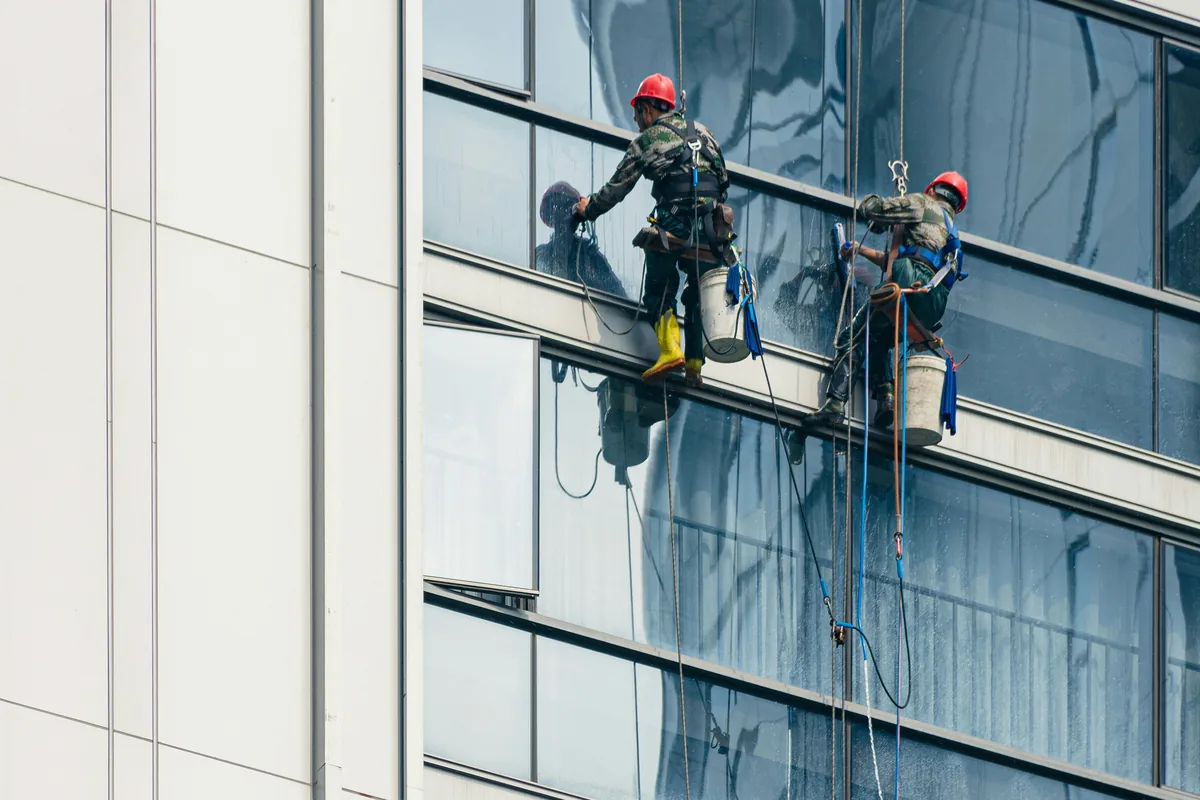
Rope access (industrial rope work). Where lifts can't reach and there's no BMU, technicians descend the building on ropes, essentially controlled rappelling, cleaning as they go. It's efficient and flexible for complex facades, but it demands serious training and certification (more on that below).
A handful of operators are also experimenting with robotic and automated systems that crawl the glass, though human crews still handle the overwhelming majority of high-rise work.
Safety is the whole game
This is the part that separates high-rise cleaning from every other kind. Working dozens of stories up is genuinely dangerous, and the entire discipline is built around not letting anything go wrong.
In the United States, high-rise work falls under OSHA regulations; in California specifically, it's governed by Cal/OSHA, which sets rules for anchorage, fall protection, equipment inspection, and rope systems. Rope-access technicians are typically certified through bodies like IRATA or SPRAT, which require documented training, supervised hours, and redundant safety systems like a working line and a separate backup line, so a single failure is never catastrophic.
For a building owner or facilities manager, the practical takeaway is simple: this is not work to hand to the cheapest bidder. A legitimate high-rise contractor will carry substantial liability insurance and workers' compensation coverage, will document its certifications, and will have a written safety plan for your building. Verifying all of that before you sign is non-negotiable — our guide to choosing a window cleaning service walks through the questions to ask, and they apply doubly here.
How often towers get cleaned
High-rise glass is usually cleaned on a recurring schedule rather than as a one-off. Many towers run a few cleanings a year for the upper exterior, with more frequent attention to the ground-floor and lobby glass the public actually sees up close. Climate and location push the frequency around: coastal salt, urban pollution, and California's wildfire-season ash all dirty exterior glass faster and can argue for extra visits.
The weather factor
One thing that surprises people about high-rise work: it's heavily weather-dependent. Crews can't safely run a swing stage or descend on ropes in high winds, rain, or lightning, and gusts only get stronger the higher up you go. That means a tower cleaning is often scheduled with built-in flexibility, can be paused mid-job when conditions turn, and may stretch across several days for a large building, all of which feeds into how the work is planned and priced.
What high-rise cleaning costs
High-rise pricing has little in common with the flat per-visit rates you'd see on a house. It's almost always bid and contracted, and the quote depends on the building's height, the access method required, the number of windows or total glass area, the cleaning frequency, and how complicated the facade is to work. A tower that needs rope access or a swing stage costs far more per visit than a low-rise storefront, simply because the labor, equipment, and risk are on a different scale. Dense urban locations can add cost too: a downtown building may require permits, sidewalk or lane closures, and traffic control just to stage ground equipment safely.
That's why you won't find a meaningful "average" price for high-rise work the way you can for homes, because every building is quoted on its own terms. Our California cost guide is a useful reference for the residential and light-commercial end of the market, but high-rise sits in a tier of its own above it.
Finding the right contractor
High-rise and large-commercial cleaning is a specialist field, and not every company that cleans storefronts is equipped to rappel a twenty-story tower. When you search, look specifically for providers who advertise high-rise or commercial capability, hold the right certifications, and have a track record on buildings like yours.
California has no shortage of demand for this work, our analysis of the state's window cleaning market found some regions skew heavily commercial, with Santa Clara County alone reporting roughly three-quarters of businesses focused on commercial work. SparklingPanes lists commercial and high-rise-capable window cleaning businesses across the state, so you can find a provider for your building wherever it is in California.